Reviewed by PRO MAX HVAC & Appliance Repair technicians, EPA 608 certified
A refrigerator leaking water on the floor almost always has one of four causes: a clogged defrost drain, a cracked or loose water supply line, a water filter that is not seated, or a drain pan that has been knocked out of place. Where the puddle starts tells you which. Water at the front points to the drain, the filter or the pan; water at the back points to the supply line or its valve.
Small leaks matter more than they look. The EPA's WaterSense program estimates that a faucet dripping once per second wastes more than 3,000 gallons a year. A slow drip at a refrigerator supply fitting adds up the same way, except it runs under the cabinet and into the subfloor, where you do not see it until the flooring lifts.
Find Where the Water Starts
Dry the floor completely, then lay paper towels along the front, both sides and as far under the back as you can reach. Check them after a few hours. The first wet towel tells you more than any guess.
If the towels at the front get wet first, look at the drain pan, the filter and the defrost drain. If the back gets wet first, the water supply line, its fittings or the inlet valve are leaking. If you find water inside the refrigerator, under the crisper drawers or frozen in the bottom of the freezer, the defrost drain is clogged.
A Clogged Defrost Drain
A clogged defrost drain is the most common reason for a refrigerator leaking water inside and, eventually, onto the floor. Several times a day, the refrigerator melts the frost off its cooling coil. That water runs through a small drain hole at the back of the freezer or the fresh food section, down a tube and into a pan underneath, where heat from the compressor evaporates it.
When food bits, mold or ice block that hole, the water backs up into the cabinet. Unplug the refrigerator first, then pour a cup of warm water into the drain hole, or use a turkey baster to push it through. If it drains slowly, repeat until it runs free.
Holiday season makes this worse. A packed freezer with bags pressed against the back wall blocks airflow, frost builds faster, and the drain freezes. Leave a little space at the back of the freezer in November and December.
If the drain clears and then freezes again within a week, the defrost heater or the drain heater has failed. That is a repair, not a cleaning job.
A Leaking Water Supply Line
A drip at the back of the refrigerator usually comes from the water supply line to the ice maker and dispenser. Here is a typical call in a Citrus Heights kitchen. The house is a 1970s ranch with an ice maker line added years later in thin plastic tubing. Someone pushed the refrigerator back after mopping, the tubing kinked against the wall and cracked, and a slow drip has been running under the cabinet for weeks.
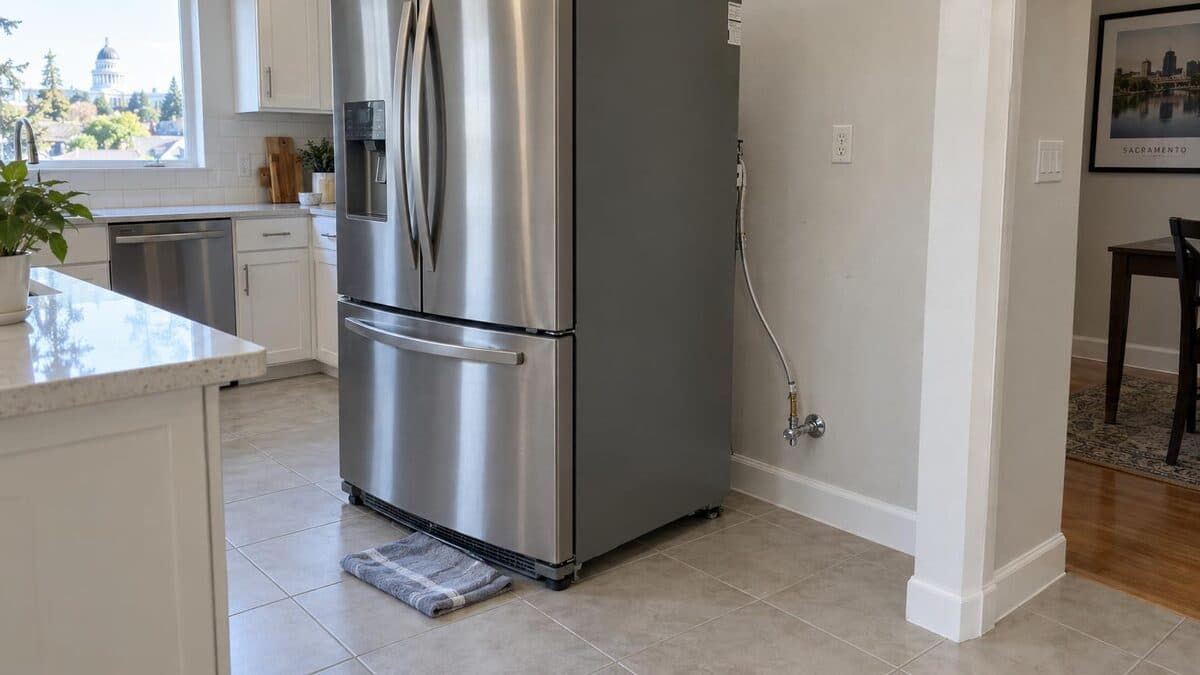
Pull the refrigerator out carefully so you do not tear the line. Look along the tubing and at both fittings for drops. If you find a leak, close the shutoff valve, which is usually behind the refrigerator or under the kitchen sink. Our position: replace old plastic tubing with a braided stainless supply line rather than patching it. It costs little and it does not crack when the refrigerator moves.
A drip right at the back of the cabinet, where the line meets the refrigerator, often means the inlet valve itself has cracked. That is a technician repair.
The Water Filter and the Drain Pan
A filter that is not fully locked leaks at its housing, inside the fresh food section or at the front grille. Twist it out and back in until it clicks. A filter housing with a hairline crack needs replacing, and so does a filter that is past its date.
The drain pan sits under the refrigerator. On some models you reach it from the front grille, on others from the back panel. With the refrigerator unplugged, look for it. Cleaning under the refrigerator often knocks the pan out of position, and an old pan can crack. Set it back in place or replace it.
While you are there, check that the refrigerator sits level side to side and slightly higher at the front. A refrigerator that leans forward lets water run the wrong way inside and keeps the doors from closing on their own.
When to Call a Pro
Call a technician when the defrost drain keeps freezing, when the inlet valve or ice maker fill tube is leaking, when water appears inside with a clear drain, or when you cannot find the source at all. Leaks from the dispenser or ice maker on French door models often hide inside the door, and those need parts and disassembly.
If your refrigerator is old and the repair is large, compare the cost with a new ENERGY STAR certified model, which uses less energy than a refrigerator built to the federal minimum.
PRO MAX HVAC & Appliance Repair handles refrigerator repair across the Sacramento area, including Citrus Heights and Rocklin. Call (916) 234-5925 or book through our online booking page.
Find and fix a refrigerator leaking water on the floor
Find where the water starts
Dry the floor, lay paper towels along the front and sides, and check them after a few hours to see whether the water appears at the front or the back.
Reseat the water filter
Remove the water filter and twist it back in until it locks, then check the housing for cracks or drips.
Flush the defrost drain
If water pools inside under the crisper drawers, unplug the refrigerator, then pour a cup of warm water into the drain hole at the back of the freezer or fresh food section to clear the clog.
Check the water line
Pull the refrigerator out carefully, look for drips at the supply line and its fittings, and close the shutoff valve if you find a leak.
Check the drain pan
With the refrigerator unplugged, find the drain pan under the refrigerator, from the front grille or the back panel depending on the model, and set it back in place or replace it if it is cracked.
Sources
Need appliance repair in the Sacramento area?
Same-day service, 180-day warranty, all major brands. PRO MAX HVAC & Appliance Repair — Carmichael, CA.