Need a technician today? Book on the AC Repair service page or call (916) 234-5925. This page is the background guide — costs, heatwave timing, and neighborhoods — not the booking page.
Why Sacramento AC fails the way it does
Sacramento's climate punishes air conditioners in a specific pattern. The summer dry heat — daytime highs above 95°F for 60+ days a year and 105°F runs that can stretch a full week — drives compressors and capacitors to their thermal limits, while wildfire smoke season (July through October) coats the outdoor condenser fins with fine particulates that further reduce heat exchange. The result: failures cluster in the first 100°F week of June and again in the longest August heat wave, with a smaller secondary peak when smoke from a Northern California fire forces extended runtimes.
The most common AC failure we diagnose isn't dramatic. It's a $40 capacitor that lost capacitance after years of repeated thermal cycling. A failed start capacitor produces one of two exact symptoms: the unit hums but the fan doesn't spin, or the fan spins but the compressor never engages. Both are inexpensive repairs that get a Sacramento home cooling again the same day.
What "same-day service" actually means in a heat wave
When PG&E reports peak grid demand and the National Weather Service has issued an excessive heat warning, every appliance repair company in the Sacramento Valley is fielding the same wave of calls. PRO MAX prioritizes:
- Households with elderly residents, infants, or anyone with respiratory conditions — these are health-and-safety calls, not comfort calls, and they jump to the front of the queue.
- Repairable failures that would otherwise become full system replacements — a capacitor failure caught quickly prevents a damaged compressor.
- Existing customers — recall priority for any system we've serviced in the past 18 months.
Carmichael, Sacramento proper, Citrus Heights, Fair Oaks, and Rancho Cordova sit inside a 15-minute drive radius of our Carmichael shop. For Roseville, Rocklin, Granite Bay, Folsom, El Dorado Hills, and Elk Grove, we typically arrive within 30–60 minutes. Auburn and Lincoln, the farthest corners of our service area, sit at 40–55 minutes. For neighborhood-by-neighborhood detail, the Neighborhood-specific AC repair links below take you to a local landing page that includes drive-time, recent reviews from that city, and any city-specific factors (well water on AC condensate lines in Orangevale, altitude calibration on Auburn furnaces, and so on).
The repair-or-replace decision
A 10-year-old AC unit at end-of-life is a common Sacramento story — most of the central-air systems installed in the building boom of 2014–2016 are now hitting that mark. Three rules of thumb after thousands of diagnostics:
- Capacitor, contactor, fan motor, thermostat: repair, even on a 12-year-old system. These are inexpensive, isolated parts; the unit will go years more without trouble.
- Refrigerant leak in the sealed system: repair if the unit is under 8 years old; lean replace if it's 10+. Older units used R-22 refrigerant, which is now extremely expensive to recharge after the EPA Section 608 phase-out.
- Compressor failure: replace if the unit is 8+ years old. The compressor is the most expensive single component, and once it's gone the rest of the system is usually close behind.
SMUD changed the math in 2025 with substantial heat-pump replacement rebates that stack with the federal 25C tax credit. For Sacramento homeowners replacing an older AC, swapping to a heat pump (which provides both cooling and heating, displacing the gas furnace) often comes out cheaper than a like-for-like AC replacement after rebates. We walk both paths during the diagnostic so the decision is informed by actual numbers, not guesswork.
What you can check before calling
Three quick checks resolve a meaningful percentage of "my AC stopped working" calls without a service visit:
- Mode and setpoint. Confirm the thermostat is set to "cool" and at least 2°F below the current room temperature. A unit stuck on "fan only" blows air without cooling it.
- Air filter. A clogged filter restricts airflow, which can ice over the evaporator coil and stop cooling. Sacramento dust clogs filters faster than the manufacturer's recommended interval; check it every 30–60 days during AC season.
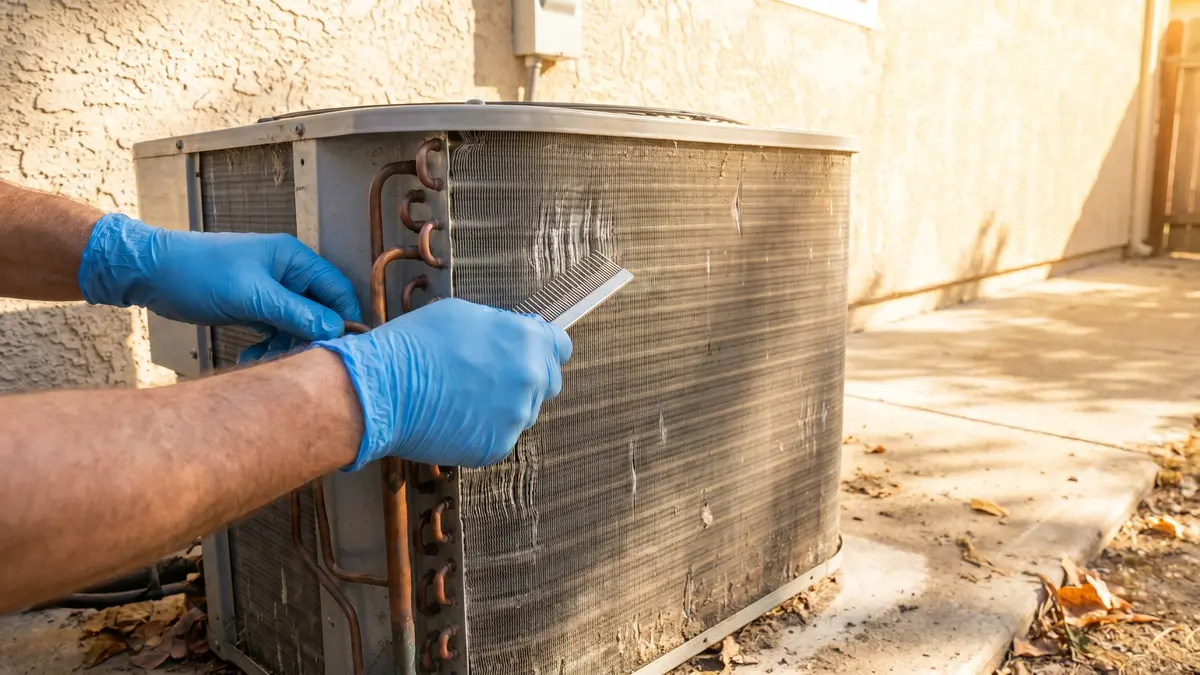
- Outdoor unit clearance. Cottonwood seeds, dust, and pet hair coat the condenser fins. With the system off, hose down the exterior of the outdoor unit to clear obvious buildup. If the fins are bent, leave them alone — bent fins compound the problem.
If those three steps don't restore cooling, the failure is something we need to diagnose with a meter. The blog post AC not blowing cold air? Common causes & fixes below walks through the next layer of checks for window and portable units specifically.