Reviewed by PRO MAX HVAC & Appliance Repair technicians, EPA 608 certified
A microwave running but not heating is sometimes just a setting, and when it is not, the cause is usually one of three parts: a door switch, the high-voltage diode or the magnetron. Rule out the settings first, because they take a minute and cost nothing. If the settings are right, the repair belongs to a technician, and the real question becomes whether your microwave is worth fixing.
The door switches are a bigger part of this than most people expect. The U.S. Food and Drug Administration sets the federal performance standard for microwave ovens, and that standard requires at least two independent interlock systems that stop microwave energy when the door opens. Those interlocks are door switches, and when one wears out, the light, fan and turntable can keep working while the heat never comes on.
Check for Demo Mode
Start with demo mode. Many microwaves have a store-display setting that runs the light, fan, turntable and countdown timer without making any heat. It can switch on by accident from a button combination, often after a power outage or a child pressing buttons.
Look at the display for DEMO, a small "d" or a similar message. The owner's manual lists the button sequence to turn it off. If you cannot find the manual, most manufacturers post them online by model number, which is on a label inside the door frame.
Check the Power Level
Next, check the power level. A microwave left on a reduced setting after defrosting will heat food very slowly, which looks like a heating failure. Set it to full power before you test.
Check the Door
Before you run any test, open and close the door and make sure it shuts firmly and latches on its own. If it does not close normally, stop using the microwave and have a technician look at it.
Run the Water Test
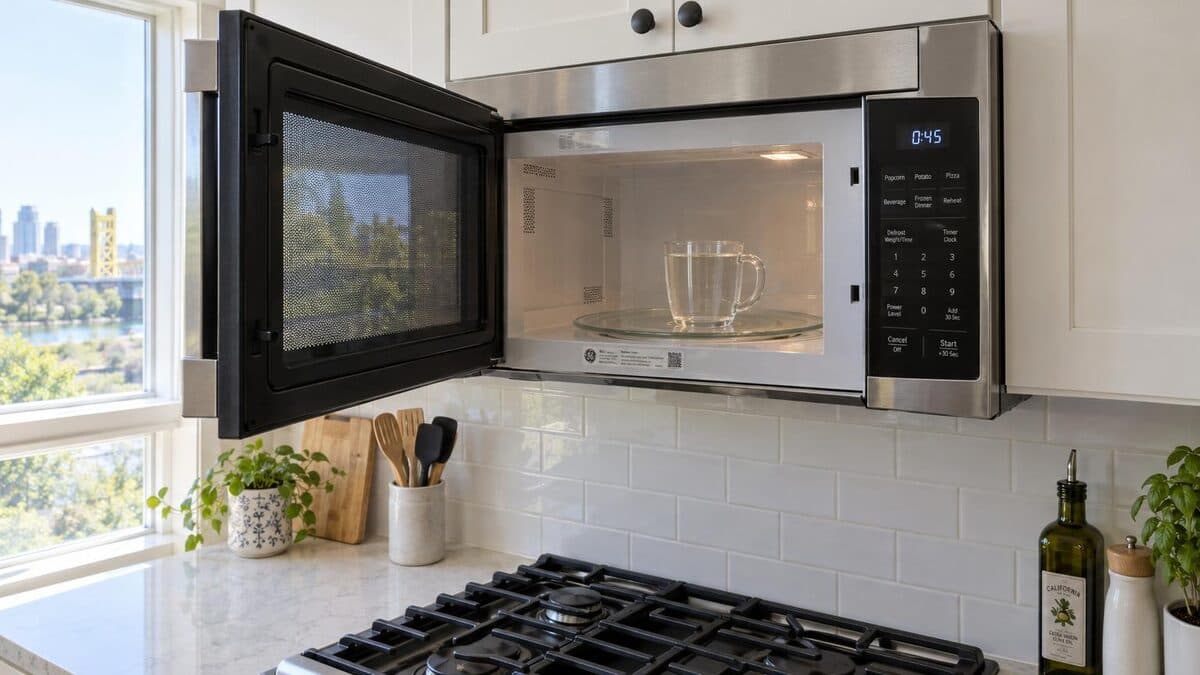
The simplest test is a cup of water. Fill a microwave-safe mug with water, set it on the turntable, and run it on high for one minute. It should come out noticeably hot.
If the water is warm but not hot, the microwave is heating weakly, which often means a magnetron that is wearing out. If the water is as cool as it went in, the microwave is not producing heat at all.
The Usual Causes
When the settings are right and the water stays cool, one of these is almost always the reason.
A door switch that has worn out is common, especially on a microwave that gets slammed. On some models, a failed switch lets everything run but blocks the heating circuit.
The high-voltage diode is another frequent failure. It is a small part in the circuit that feeds the magnetron, and when it fails, the microwave runs normally with no heat.
The magnetron is the part that actually makes the heat. It wears out with years of use, and a failing one often shows up first as weaker heating before it stops entirely.
Less often, the cause is the high-voltage capacitor, the transformer or the control board. Testing all of these takes the cabinet off, and the inside of a microwave is not a homeowner repair, so unplug it and leave the cover on.
Repair or Replace?
For a basic countertop microwave, replace it. A new countertop model often costs about the same as a service call plus a magnetron, and you get a fresh warranty.
For an over-the-range or built-in microwave, repair is often worth it. Replacing one means finding a model that fits the same opening and mounting plate, removing the old one, and sometimes adjusting the cabinet or the vent connection. A door switch or diode is a modest repair by comparison. In a lot of Roseville kitchens remodeled in the last ten or fifteen years, the over-the-range microwave matches the range and the cabinets, which makes a like-for-like repair more attractive still.
Before paying for parts, check the U.S. Consumer Product Safety Commission site for recalls on your model.
When to Call a Pro
Call a technician when the water test shows no heat or weak heat after you have ruled out demo mode and the power level, when the door needs force to latch, or when the microwave trips a breaker or blows its internal fuse. A technician can test the door switches, diode, capacitor and magnetron and tell you which one failed and what the repair costs.
Our position: check demo mode and the power level yourself, then replace a countertop model and repair an over-the-range or built-in one. The deciding factor is how much work replacement means, not the price of the microwave alone.
A typical case looks like this: an over-the-range microwave eight or nine years old, a door that closes normally, and food that comes out cold even though everything sounds normal. A failed door switch or diode is the usual finding.
PRO MAX HVAC & Appliance Repair handles microwave repair for over-the-range and built-in models across the Sacramento area. Call us at (916) 234-5925 or book a visit online on our contact page.
How to check a microwave that runs but will not heat
Check for demo mode
Look for DEMO or a similar message on the display and use the button sequence in your manual to turn it off.
Check the power level
Make sure the power level is set to high, not a reduced level left over from defrosting.
Check the door first
Make sure the door closes firmly and latches on its own. If it does not close normally, stop using the microwave and have a technician check it.
Run the water test
If the door closes normally, heat a microwave-safe cup of water on high for one minute. It should come out noticeably hot.
Call for a diagnosis
If the water stays cool, unplug the microwave and have a technician test the door switches, diode and magnetron.
Sources
Need appliance repair in the Sacramento area?
Same-day service, 180-day warranty, all major brands. PRO MAX HVAC & Appliance Repair — Carmichael, CA.