Reviewed by PRO MAX HVAC & Appliance Repair technicians, EPA 608 certified
A dishwasher not drying dishes is usually out of rinse aid, running a cycle that skips heated dry, or starting with cool water, and none of those needs a repair. Work through them in order before you look at parts. Water temperature is the one people miss. The U.S. Consumer Product Safety Commission recommends setting a home water heater to 120°F to prevent scalding, and that is also about where a dishwasher wants its supply to start. If the first fill comes out of a long pipe run at room temperature, the whole cycle runs cooler, and the dishes have less heat left to dry with at the end.
Here is how to sort out which cause you have.
Know How Your Dishwasher Dries
Your dishwasher dries one of two ways, and which one it uses changes what "wet" means.
Many older and budget models have an exposed heating element, a black loop along the bottom of the tub. During the dry phase it heats the air, and some models add a small vent fan to push the moist air out. Many newer machines, including most Bosch models, have no exposed element at all. They finish with a very hot rinse and let the moisture condense on the cooler stainless tub walls. Bosch's CrystalDry models add a mineral that releases heat to help.
Condensation drying is gentler and quieter, but it is slower and it depends heavily on rinse aid. If you replaced an old machine with a new condensation model and started finding wet cups, the machine is working as designed. The fixes below still help.
Refill the Rinse Aid
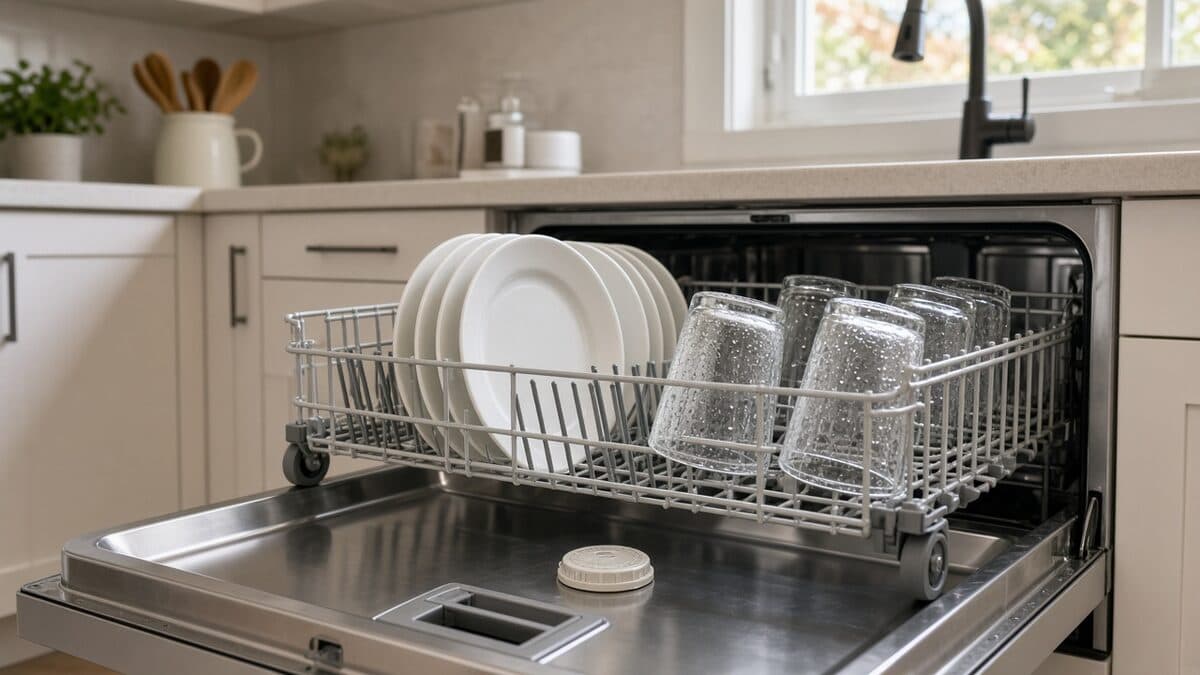
Rinse aid is the most common fix, and on condensation-dry machines it is not optional. It lowers the surface tension of the final rinse so water sheets off the dishes instead of sitting in beads.
Open the small cap on the inside of the door, usually next to the detergent cup, and fill it to the line. Most dispensers have an indicator that shows dark when full and clear when empty. If dishes still come out wet or spotted after a few loads, turn up the dose setting under the cap one step at a time.
Check the Dry Setting and Cycle
If the rinse aid is full, look at the settings. Heated dry, extra dry or a sanitize option is often off by default, and eco and quick cycles shorten or skip drying to save energy and time. Efficiency-focused machines, including ENERGY STAR certified models, often default to cycles tuned to save energy, so the default is rarely the driest option.
Run one load with heated dry or extra dry turned on. If that fixes it, you have your answer. Leave it on for loads with lots of glass and plastic, and skip it for everyday loads if you would rather save the energy.
Start With Hot Water
Before you start the machine, run the kitchen tap until the water comes out hot. It takes under a minute and costs almost nothing.
This matters most in houses where the water heater sits in the garage on the far side of the house, a common layout in 1970s tract homes around Rancho Cordova. The first gallon or two in the line has been sitting at room temperature, and on many machines that cool water is the first fill.
Load and Unload for Drainage
How you load and unload changes the result more than people expect. Cups and bowls that sit flat hold a puddle in their bases. Nested bowls trap water between them. Plastic containers flip over and fill up.
Tilt everything so water runs off. Leave space between pieces so air and heat can move. Then unload the bottom rack first. The top rack almost always has a little water pooled on the upturned bottoms of cups, and unloading it first dumps that water onto the dry dishes below.
Plastic stays wetter than glass on every dishwasher. It holds less heat, so the water on it does not evaporate or condense away the way it does on a heavy plate. Tilt plastics on the top rack and give them a few minutes on a towel.
The dry Sacramento summer air helps here. Cracking the door open a few inches at the end of the cycle lets the steam out, and in September most loads finish air-drying within about half an hour.
When Drying Fails on a Heated-Dry Cycle
If rinse aid is full, heated dry is on, the water starts hot, and glass and ceramic still come out soaked, a part has usually failed. On machines with a visible element, the typical culprits are the heating element itself, the high-limit thermostat that protects it, the vent fan, or the control board that powers them.
A typical call for this goes like this: the machine is eight or nine years old, it still cleans well, and drying got worse over a few weeks and then stopped. A meter test at the element usually shows the break, and replacing it restores drying.
When to Call a Pro
Call a technician when dishes stay wet after you have fixed rinse aid, settings, water temperature and loading, or any time you smell burning, see scorch marks near the element, or find a tripped breaker after a cycle. Testing the element and thermostat means pulling the kick plate and working near line voltage, so leave it to someone with a meter.
Our position: fix the rinse aid and settings yourself, because they solve most of these complaints for the price of a bottle. Pay for a repair only when a heated-dry cycle stops drying glass, and on a machine older than about ten years, weigh that repair against a new condensation-dry model.
PRO MAX HVAC & Appliance Repair handles dishwasher repair across the Sacramento area. Call us at (916) 234-5925 or book a visit online on our contact page.
How to get a dishwasher drying again
Refill the rinse aid
Open the rinse aid cap on the inside of the door and fill it to the line. Raise the dose setting if dishes still come out wet or spotted.
Turn on heated dry
Check that heated dry, extra dry or a sanitize option is selected. Eco and quick cycles often skip or shorten drying.
Start with hot water
Run the kitchen tap until the water is hot before you start the cycle, so the machine does not begin with cold water from the line.
Load and unload for drainage
Tilt cups and bowls so water runs off, avoid nesting, and unload the bottom rack first so the top rack does not drip onto it.
Call if parts are suspect
If glass and ceramic are still soaked on a heated-dry cycle, have a technician test the heating element, high-limit thermostat and vent fan.
Sources
Need appliance repair in the Sacramento area?
Same-day service, 180-day warranty, all major brands. PRO MAX HVAC & Appliance Repair — Carmichael, CA.