Reviewed by PRO MAX HVAC & Appliance Repair technicians, EPA 608 certified
A dishwasher not filling with water usually has a shutoff valve under the sink that is closed or only partly open, a supply line kinked behind the dishwasher, or a float stuck in the raised position. Check those three first, because each takes about a minute. If the dishwasher hums and still no water comes in, the inlet valve or its screen has failed or clogged, and that is a technician repair.
It helps to know what a normal fill looks like, because modern dishwashers use very little water. Under the current specification, ENERGY STAR certified standard-size dishwashers use no more than 3.2 gallons per cycle, spread over several fills. A shallow pool covering the sump at the bottom of the tub is normal. A dry tub after the first couple of minutes is not.
Some brands make that hard to judge. Many European-style dishwashers, Bosch among them, fill so little at the start that the water barely shows around the filter, and they add more in later fills as sensors read how dirty the load is. Pause the cycle a few minutes in, let the spray stop, then open the door and look at the sump under the filter rather than the tub floor. Water there, even a shallow amount, means the fill is working.
Start at the Shutoff Valve
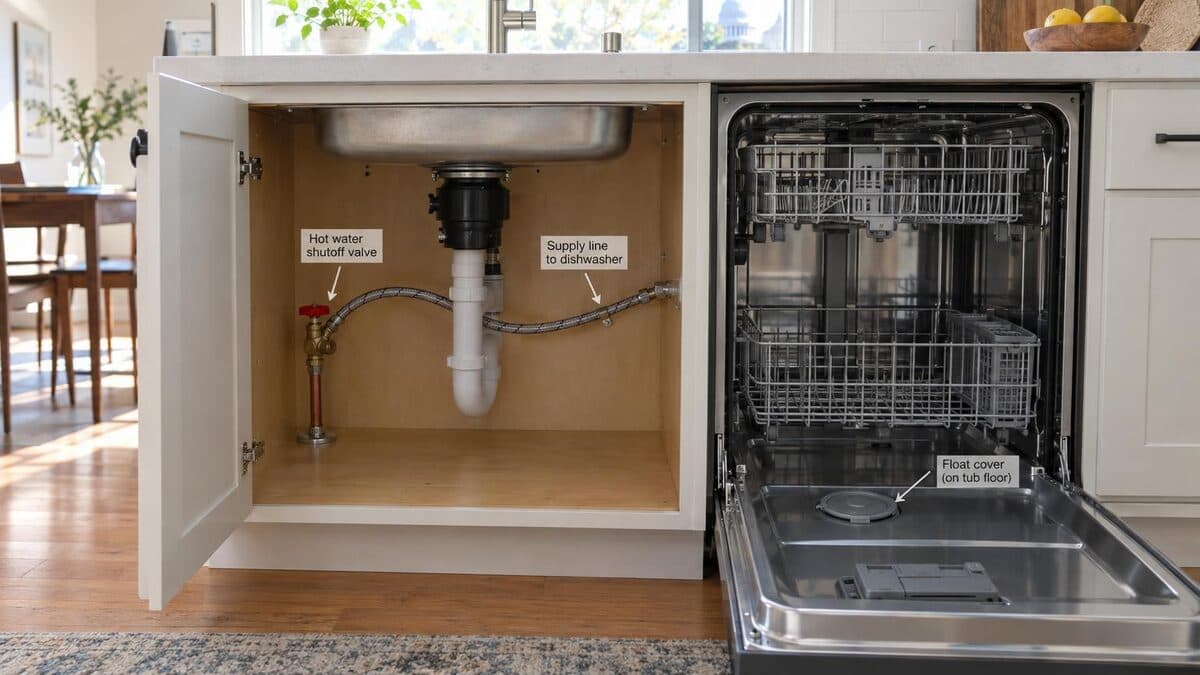
Look under the kitchen sink first. Most dishwashers draw from a small valve on the hot water line, often a two-outlet valve with one handle for the faucet and one for the dishwasher. After any plumbing work, a garbage disposal swap or a new faucet, that valve is frequently left closed or only a quarter open. Turn it fully open, counterclockwise, and start a short cycle.
If the faucet's hot water is weak too, the problem is upstream of the dishwasher, such as a partly closed main or a water heater valve, and the dishwasher is fine.
Check the Supply Line
The supply line runs from that valve, through the cabinet wall and under the dishwasher. A line that was pushed back against the wall when the dishwasher was installed, or crushed when someone stored cleaning supplies under the sink, can kink enough to choke the flow.
Straighten anything you can see. Older homes often have thin copper tubing here that kinks permanently once it folds. Our position: replace a kinked copper line with a braided stainless one rather than trying to straighten it. It costs little and the next kink never happens.
Free the Float
The float is a small dome or cylinder on the tub floor, usually in a front corner. On most models it is an overfill safety: if water rises too high, it lifts and shuts the fill off. When food, a broken glass shard or hard-water scale holds it up, the dishwasher reads an overfill before it starts and never opens the water valve.
With the dishwasher off, lift the float or its cover and let it drop. It should move up and down freely with a soft click from the switch underneath. Clean around it if it sticks.
Latch the Door
Most dishwashers will not fill unless the door switch reads closed. A latch that does not quite catch, a rack pushed out past the door, or a worn latch that no longer clicks lets the control run its lights and timer without ever calling for water. Close the door firmly until it clicks, and make sure nothing on the racks blocks it.
Then try a cycle.
When It Hums but No Water Comes In
A hum or buzz at the start of a cycle with no sound of water means the control is calling for water and the inlet valve is not opening. The valve sits behind the kickplate at the bottom front, with a fine mesh screen where the supply line connects.
In homes that get groundwater, that screen collects sediment and scale. A clogged screen produces a slow, weak fill and dishes that come out dirty; a failed valve coil produces no fill at all. Both need the dishwasher's power off at the breaker and the water shut off, then the kickplate removed, and the valve is usually replaced rather than cleaned.
Here is a typical call in Citrus Heights. A kitchen faucet was replaced the week before, and now the dishwasher runs through its cycle with a dry tub. Under the sink, the two-outlet valve has its faucet handle open and its dishwasher handle still closed from the install. Opening that handle has the dishwasher filling in seconds, with no parts needed.
When to Call a Pro
Call when the valve is open, the line is straight, the float moves and the door latches, yet the dishwasher still will not fill. Call too if it fills slowly and dishes come out dirty, if the dishwasher hums at the start of each cycle, or if you see water under the front kickplate. Check the CPSC recall database with your model number as well.
PRO MAX HVAC & Appliance Repair handles dishwasher repair across the Sacramento area, including Citrus Heights and Rancho Cordova. Call (916) 234-5925 or book through our online booking page.
Check a dishwasher that is not filling with water
Open the shutoff valve
Look under the kitchen sink for the valve on the hot water line that feeds the dishwasher and turn it fully open.
Check the supply line
Look for a kink or a crushed section in the supply line where it runs from the valve toward the dishwasher.
Free the float
With the dishwasher off, lift the float or its cover on the tub floor and make sure it moves up and down freely.
Latch the door firmly
Close the door until it clicks, since most dishwashers will not fill unless the door switch reads closed.
Listen during the fill
Start a cycle and listen; a hum with no water flowing points to the inlet valve, which needs a technician.
Sources
Need appliance repair in the Sacramento area?
Same-day service, 180-day warranty, all major brands. PRO MAX HVAC & Appliance Repair — Carmichael, CA.