Reviewed by PRO MAX HVAC & Appliance Repair technicians, EPA 608 certified
A Sub-Zero refrigerator needs less maintenance than its price suggests, but the few jobs it does need matter more than they would on a freestanding fridge. Clean the condenser every six months, change the water filter on schedule, check the door gaskets two or three times a year, and book a yearly service visit for the parts you cannot test yourself.
The goal of all of it is simple: hold the fresh-food side at or below 40°F and the freezer at 0°F, the storage temperatures the U.S. Food and Drug Administration recommends. A built-in that drifts above those numbers is telling you something, usually about airflow.
Why a Built-In Sub-Zero Needs Different Care
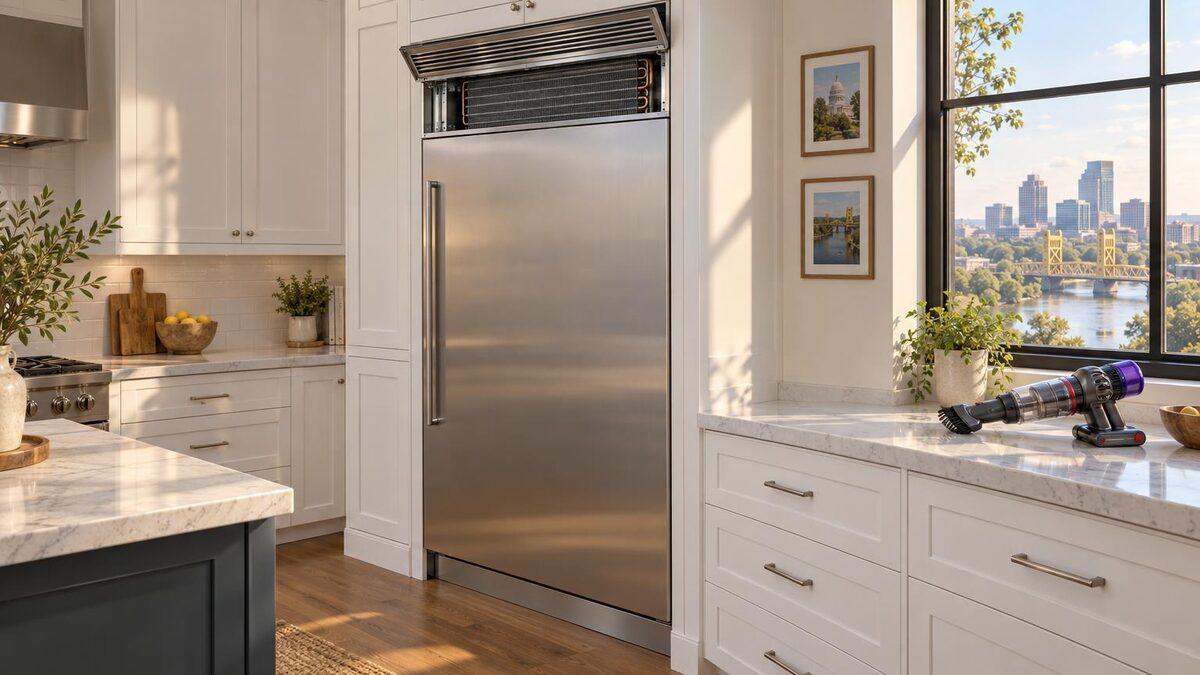
A built-in Sub-Zero needs different care because it has nowhere else to breathe. A freestanding fridge pushes heat out the back and the sides, into the gap between the cabinet and the wall. A built-in sits flush in cabinetry with no gap at all, so it pulls cool room air in through one grille and pushes hot air back out through the same opening.
That design is why these units look the way they do. It also means a grille felted with dust chokes the whole system, not just one side of it.
Most Sub-Zero models also use dual refrigeration: separate cooling systems for the fresh-food and freezer sections. That is good for food, because the freezer's dry air never mixes with the produce drawers. It also means one side can fail while the other runs fine, and a homeowner sees "the fridge is warm, the freezer is fine" and assumes the problem is small.
Clean the Condenser Every Six Months
The condenser is the one maintenance job that prevents the most Sub-Zero refrigerator repair calls. Clean it every six months, and every three months in a house with a shedding dog, a recent remodel or a kitchen near an open patio door.
Turn the unit off at its control panel or at the breaker first. The grille sits above the doors on most built-ins and at the base on integrated models; your owner's guide shows how it tilts or lifts off. Behind it you will find the condenser coil and its fins.
Use a vacuum with a soft brush attachment and work along the fins, top to bottom, until you see metal instead of a gray mat. Skip the coil-cleaning sprays and the stiff brushes. Bent fins block airflow just as well as dust does, and they do not vacuum back out.
The whole job takes about fifteen minutes.
Water Filter and Door Gaskets
Change the water filter when the indicator lights or at least every six months, whichever comes first. A tired filter slows the dispenser and makes small, hollow ice cubes. Some Sub-Zero models also carry an air purification cartridge in the fresh-food section; it has its own indicator, and it is worth keeping current if you store a lot of produce.
Door gaskets take two minutes. Close a door on a dollar bill at several points around the seal and pull it out. You want steady drag. If the bill slides out freely at any spot, warm kitchen air is getting in there.
Wipe the door gaskets with warm, soapy water when you check them, and dry them. Sticky spills from the door shelves glue a gasket to the cabinet and tear it when the door opens, which is one of the most common reasons a fairly new built-in needs a gasket.
Replace a door gasket that is torn, flattened, stiff or fails the bill test in more than one place. On any refrigerator, a leaking seal shows up as frost on the freezer walls, sweat on the door frame and a compressor that rarely shuts off.
A Typical Neglected-Condenser Call
A typical call from an older kitchen in Carmichael goes like this: a built-in from the 600 series, close to twenty years old, with a fresh-food side reading 46°F and a compressor that never cycles off. The homeowner has already turned the dial colder twice. Behind the grille, the condenser is covered in a layer of dust thick enough to peel off in a sheet.
Cleaning it brings the temperature down over the next several hours. Turning the dial colder never would have, because the system was already running flat out and losing the fight.
That is the pattern worth knowing. When a Sub-Zero refrigerator is not cooling, the first check is the condenser, not the thermostat.
What a Yearly Service Visit Covers
A yearly service visit covers the parts a homeowner cannot test with a vacuum and a dollar bill. Our position: it is worth doing every year once a unit is past its warranty, because a Sub-Zero is built to be repaired, and the repairs that hurt are the ones caught late.
On that visit a technician should:
- Clean the condenser fully, including areas the vacuum cannot reach from the front.
- Check the condenser and evaporator fan motors for bearing noise and correct speed.
- Confirm both systems reach temperature and cycle off normally.
- Inspect the defrost drain, since a blocked drain causes ice under the crisper drawers.
- Check the door closers and hinges, so each door closes and seals on its own.
- Look at the ice maker and water valve for slow fills or leaks.
Ask what they measured. A technician who checked both systems can tell you how long each one ran to reach temperature, and that becomes the baseline for next year.
Efficiency is part of the case too. An ENERGY STAR certified refrigerator is about 9 percent more efficient than the federal minimum, and a clogged condenser gives that advantage back.
When to Call a Pro
Call a pro when the condenser is clean and either section still runs above 40°F or 0°F, when frost keeps forming after the door gaskets pass the bill test, or when you hear a new grinding or clicking from behind the grille. Water under the crisper drawers and an ice maker that has stopped are also service calls, not DIY projects. Leave anything involving the sealed system or the control board to a technician trained on these units.
PRO MAX HVAC & Appliance Repair sends factory-trained technicians for Sub-Zero refrigerators across the Sacramento area. Call (916) 234-5925 or book a visit on our contact page to get your built-in checked.
How to do routine Sub-Zero refrigerator maintenance
Shut off power
Turn the unit off at its control panel or switch off its breaker before you touch the grille or condenser.
Open the grille
Tilt or lift off the grille panel as your owner's guide shows, usually above the doors on a built-in or at the base on an integrated model.
Vacuum the condenser
Run a soft brush attachment along the condenser fins in the direction they run, top to bottom, until no gray felt of dust remains.
Check the gaskets
Close each door on a dollar bill at several points around the seal; if it slides out with no drag, that section is not sealing.
Replace the filters
Swap the water filter and, on models that have one, the air purification cartridge when the indicator calls for it.
Restore power and check temperatures
Turn the unit back on and confirm the fresh-food side settles at or below 40°F and the freezer at 0°F.
Sources
Need appliance repair in the Sacramento area?
Same-day service, 180-day warranty, all major brands. PRO MAX HVAC & Appliance Repair — Carmichael, CA.