Reviewed by PRO MAX HVAC & Appliance Repair technicians, EPA 608 certified
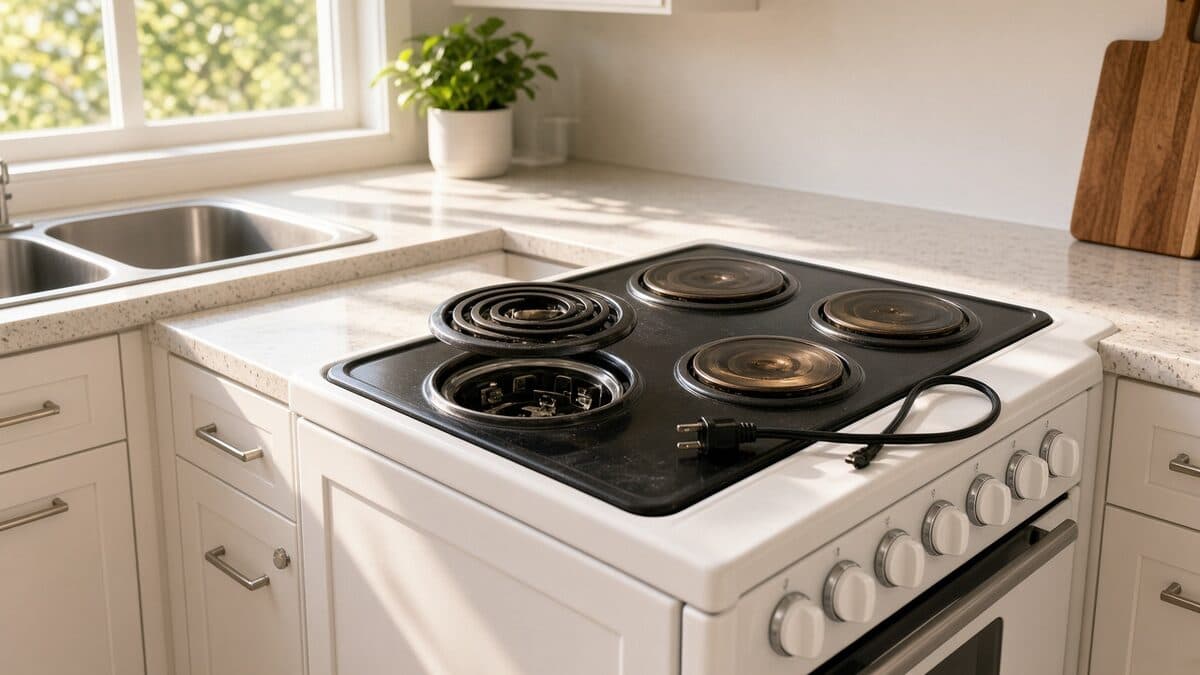
One electric burner that stays cold while the others heat is almost always a failed coil, a worn receptacle, or a bad infinite switch. It is not a gas igniter problem and not an oven fault. Each coil on an electric range has its own circuit, so when one part on that path gives out, only that burner goes dark. Before you touch anything, unplug the range or switch off its breaker. Leave the receptacle to a technician, because it carries full element current.
This matters for more than convenience. The U.S. Fire Administration reports that cooking is the leading cause of residential building fires, responsible for roughly half of them. A burner with scorched wiring behind it is not something to keep poking at while the range is live.
Why Only One Burner Fails
Only one burner fails because each coil runs through its own receptacle and its own infinite switch, and nothing on that path is shared with the other three. When the front-left coil dies, the front-right keeps working because its parts never saw the fault.
Summer is hard on these parts. Around Citrus Heights, plenty of households skip the oven from June through September to keep from heating the house during 100-degree streaks. They lean on the stovetop instead, and if they are on SMUD's Time-of-Day rate they often cook early to stay out of the weekday 5 to 8 p.m. summer peak window (the current schedule is on SMUD's site). Either way, that burner goes through hundreds of heat-and-cool cycles in a season. Metal expands and contracts every time. The coil's terminals loosen a little in the receptacle, the connection starts to arc, and the arcing burns both the prongs and the socket. Eventually the coil opens inside or the socket stops making contact.
The three culprits, in the order we find them:
- The coil itself. The heating wire inside the sheath breaks. Sometimes you can see a blister or a split; often you cannot.
- The receptacle. The ceramic socket the coil plugs into. Heat and arcing brown the terminals, weaken the spring contacts, or crack the ceramic.
- The infinite switch. The knob-controlled switch that cycles power to the burner. When its contacts wear out, it stops sending power at any setting, or only on high.
How to Test a Single Electric Coil Burner
The swap test tells you whether the coil is bad in about five minutes, with no tools. Here is how to do it safely:
- Unplug the range or turn off its breaker at the panel. A range runs on a 240-volt circuit, and the U.S. CPSC advises disconnecting power before checking any appliance.
- Let the coils cool completely. Give it at least 30 minutes after the last use.
- With the range still unplugged, lift the cold coil slightly at the front and pull it straight out. Look at that coil, a same-size coil that still heats, and both receptacles. Stop if you see a split, blister, or burned spot, or if the prongs or sockets are pitted, blackened, or melted. Do not plug a damaged coil into the working receptacle, and do not restore power. Replace a split or blistered coil only while power stays off. If the prongs or a receptacle are scorched, call a technician.
- Only when both coils and both receptacles look undamaged, swap the cold coil with a same-size coil from a burner that works. Most coil ranges have two 6-inch and two 8-inch elements, so trade small for small or large for large.
- Confirm both burner controls are set to OFF before you restore power, then turn on and test one burner at a time. Skip this step when step 3 found damage. If the failed burner's control was left on, reconnecting the plug or breaker can arc at the range plug and heat the known-good coil before you deliberately begin the test.
- Turn both burner controls off, disconnect power again by unplugging the range or switching off its breaker, and let the elements cool before you touch either coil. Do not pull a swapped element while the 240-volt range is still live — that can cause shock, arcing, or burns, and the known-good coil may be hot.
Before you handle either coil, finish the shutdown in step 6: turn both controls off, disconnect power again, and let the elements cool. Do not replace the failed coil, or pull either swapped element, while the 240-volt range is still live — that can cause shock, arcing, or burns, and the known-good coil may be hot. Read the result only after that, and only if step 3 found no damage. If step 3 found a split, blister, pitted prongs, or a scorched receptacle, leave the range unplugged. If the suspect coil stayed cold in the working spot, and the known-good coil heated in the original spot, the coil is burned out. If the dead spot stayed dead no matter which coil you plugged in, the coil is fine and the problem is the receptacle or the infinite switch. Leave both coils in place until power is off and they have cooled.
A coil can look perfect and still be open inside. When both coils and both receptacles look undamaged, do not skip the swap. When you see damage, stop and do not energize the range.
What a Bad Receptacle Looks Like
A bad receptacle usually shows itself through the coil's prongs before you ever see the socket. Pitted, blackened, or melted-looking prongs mean the connection has been arcing. Other signs are a coil that wobbles or will not sit flat, a burner that works only when you press on it, or a faint hot-plastic smell when it is on.
Here is where I will take a firm position. Never put a new coil into a scorched receptacle. The burned socket will chew up the new coil's prongs within weeks, and you will be buying another one. If the prongs on your old coil are pitted, the receptacle gets replaced along with it. Every time.
Last month we had a call in a 1970s tract house in Citrus Heights with the original layout and a newer coil range. The owner had already bought and installed two replacement 8-inch coils for the front-left burner over the summer. Both died. When our technician pulled the drip pan, the receptacle terminals were brown and the ceramic had a hairline crack. The coils were never the root problem. New receptacle, new coil, and the burner has been fine since.
When It Is the Infinite Switch
The infinite switch is the likely culprit when the swap test clears the coil and the receptacle shows no burn marks. Switch failures show up as a burner that stays cold on every setting, heats only on high, or runs full blast and ignores the knob. You may also hear the switch click without the coil warming.
The switch lives behind the control panel, connected to 240-volt wiring. Testing it properly takes a multimeter and a wiring diagram for your specific range. This is a reasonable repair, not a reason to replace the stove, but it is technician work.
Is It Safe to Keep Cooking
You can keep cooking on the burners that still heat as long as the dead coil is only cold and shows no other symptoms. Leave that burner's knob off until it is repaired.
Unplug the range and stop using it if you see any of these:
- Sparks or smoke from the dead burner
- A hot-plastic or burning smell
- Scorch marks around the receptacle or drip pan
- A coil that will not sit flat
- A breaker that trips when you turn that burner on
Those point to arcing at the receptacle or a wiring fault, and that is a fire risk, not an inconvenience.
Replace the Coil or the Whole Stove
Replace the coil, not the stove, when the swap test shows only the element is dead. A bad receptacle or infinite switch is also a repair, not grounds to scrap a working range. One cold coil after a summer of daily cooking rarely means the stove is finished.
Replacement makes sense when several burners are failing, the cooktop surface is warped, or the repair bill approaches the price of a basic range. Short of that, fix it.
When to Call a Pro
Call a pro when the swap test points past the coil, or anytime you see burn marks, smell hot plastic, or trip the breaker. Receptacle and infinite switch replacements put your hands near connections that carry full element current on a 240-volt circuit. A technician can confirm the failed part with a meter, replace a scorched receptacle and pitted coil together so the fix lasts, and check the wiring behind the cooktop for heat damage you cannot see from above.
If one burner on your electric range has gone cold, PRO MAX HVAC & Appliance Repair serves Citrus Heights and the Sacramento area. Call us at (916) 234-5925, or book a visit online through our contact page.
Sources
Need appliance repair in the Sacramento area?
Same-day service, 180-day warranty, all major brands. PRO MAX HVAC & Appliance Repair — Carmichael, CA.