Reviewed by PRO MAX HVAC & Appliance Repair technicians, EPA 608 certified
If you installed a new thermostat and the heat is not working, the furnace is almost never the problem. The setup is. Four things cause nearly every case: the thermostat is set for the wrong kind of system, the heat wire landed on the wrong terminal, a smart thermostat has no steady power, or the furnace's low-voltage fuse blew during the swap. Check them in that order.
The upgrade is still worth finishing. ENERGY STAR estimates that its certified smart thermostats save about 8 percent on heating and cooling bills. But that saving only starts once the thing actually turns the furnace on, and the first cold week of November is when a summer DIY swap gets its first real test.
Before you touch any wires, turn the furnace off at its power switch, the light-style switch on or next to the furnace.
Check the System Type Setting
The system type setting is the most common reason a new thermostat will not turn on the heat. Every thermostat asks during setup what it is controlling, and the default is not always right for your house.
For a gas furnace with central air, choose conventional or forced air. For a heat pump, choose heat pump, and then set the reversing valve option, usually labeled O or B, to match the wire you connected.
A thermostat set to heat pump on a furnace system sends the heat call on the wrong wire, and the furnace never hears it. A heat pump with the O/B setting backward does the reverse of what you ask: heat mode blows cool air and cool mode blows warm. If that is what you are seeing, flip that one setting.
Compare the Wiring to Your Photo
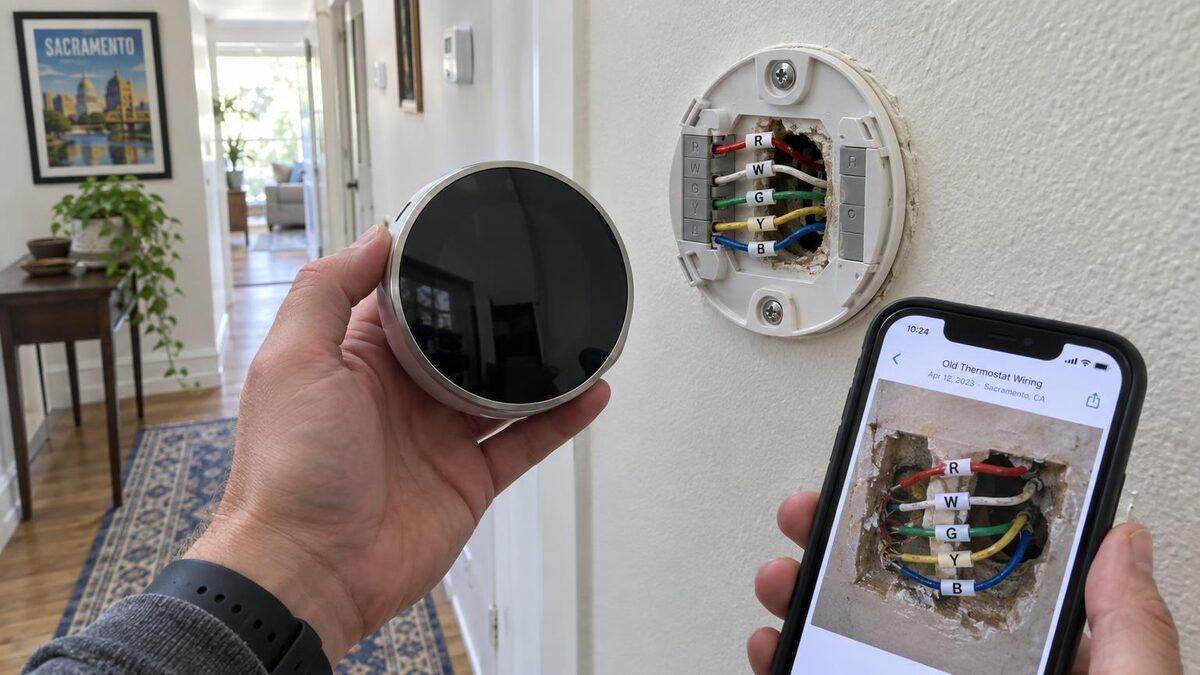
The heat wire belongs on W or W1, and power belongs on R or Rh. Pull up the photo of the old thermostat's wiring, and if there is no photo, look at the furnace end of the cable, where the wires connect to the control board with the same letters.
Common mix-ups:
- The white wire went on a terminal labeled for the second stage or auxiliary heat instead of W1.
- A wire that was tucked behind the old base plate, unused, got connected and now confuses the thermostat.
- A wire stripped too short is not making contact in the push-in terminal. Tug each one gently.
Wire colors are a habit, not a rule. Some installers used whatever color was handy, so the letter on the old thermostat and the letter on the furnace board matter more than the color.
The R Jumper and the C-Wire
Many homes have a single red wire, and many new thermostats have two R terminals, Rh and Rc. With one red wire, those two terminals need to be connected. Some thermostats do it with a jumper or a switch; some do it in the setup menu. Skip it, and the thermostat can run the AC but never the heat, or the other way around.
Smart thermostats need a C-wire, the common wire that gives them steady power from the furnace. Without one, many models drain their batteries, reboot, or drop the heat call halfway through a cycle. Plenty of 1970s and 1980s houses around Sacramento and Roseville have an extra wire already sitting in the bundle, folded back and unused. At the furnace, that spare connects to the C terminal, and the problem goes away.
"Waiting for Equipment" Is Usually Normal
A new thermostat that says "waiting for equipment" is running a built-in protective delay before it starts the system, usually up to about five minutes. Resideo, which makes Honeywell Home thermostats, builds that delay in to protect equipment from rapid restarts after a setting change or a power interruption.
Give it five minutes. Changing settings while it waits restarts the clock. If the message stays and nothing starts after that, go back to the system type and wiring.
Installed a New Thermostat and Now Nothing Works
If the heat, the fan and the screen all died after the swap, the low-voltage fuse on the furnace control board has almost certainly blown. That happens when the red and common wires touch while the furnace still has power, which is easy to do when a wire springs out of the wall.
Here is a typical call after a weekend install: a new smart thermostat, a blank screen, a furnace with no response at all, and a small 3- or 5-amp fuse on the control board with a broken strip inside. The fuse costs a few dollars. The real work is making sure nothing is still shorted before a new one goes in, because a new fuse on a shorted wire blows just as fast.
Our position: if you see a blown fuse, stop there and have it checked. Replacing fuses until one holds hides a wiring fault instead of fixing it.
When to Call a Pro
Call a technician when the system type and wiring are right and the heat still does not come on, when the furnace fuse has blown, or when your old wiring had more wires than the new thermostat has terminals, as with some two-stage furnaces and heat pumps with auxiliary heat. Those need a meter and a look at the furnace end of the wire.
PRO MAX HVAC & Appliance Repair handles thermostat installation and furnace repair across the Sacramento area. Call (916) 234-5925 or book a visit on our contact page, and we will get the new thermostat and the furnace talking.
How to fix heat that stopped working after a thermostat swap
Check the system type
In the thermostat's setup menu, confirm it is set to conventional forced air for a furnace, or heat pump with the right O or B setting for a heat pump.
Compare the wiring to your old photo
With the furnace power switch off, make sure the white heat wire is on W or W1 and the red power wire is on R or Rh.
Check the R jumper and C-wire
If you had one red wire, keep the Rh and Rc terminals jumpered when the thermostat calls for it, and confirm a smart thermostat has a C-wire.
Wait out the equipment delay
If the screen says waiting for equipment, give it five minutes before changing anything.
Check the furnace fuse
If nothing works at all, look for a blown small automotive-style fuse on the furnace control board and have it checked before replacing it.
Sources
Need appliance repair in the Sacramento area?
Same-day service, 180-day warranty, all major brands. PRO MAX HVAC & Appliance Repair — Carmichael, CA.