Reviewed by PRO MAX HVAC & Appliance Repair technicians, EPA 608 certified
An upright freezer not freezing usually has a door seal that leaks, heavy frost on a manual-defrost model, condenser coils caked with dust, or packages blocking the air vent. On a frost-free model, a top shelf that stays soft points to a failed defrost heater, defrost timer or evaporator fan. Check the seal, the frost and the coils yourself; the defrost and fan parts are a technician repair.
Frost is the first thing to look at on a manual-defrost model, because it builds up quietly. The U.S. Department of Energy advises defrosting manual-defrost refrigerators and freezers before the frost gets thicker than about a quarter inch, because frost insulates the cooling coils and makes the freezer work harder. Past that point, the shelves stop pulling heat out of the food as fast as the door lets it in.
Know Which Kind You Have
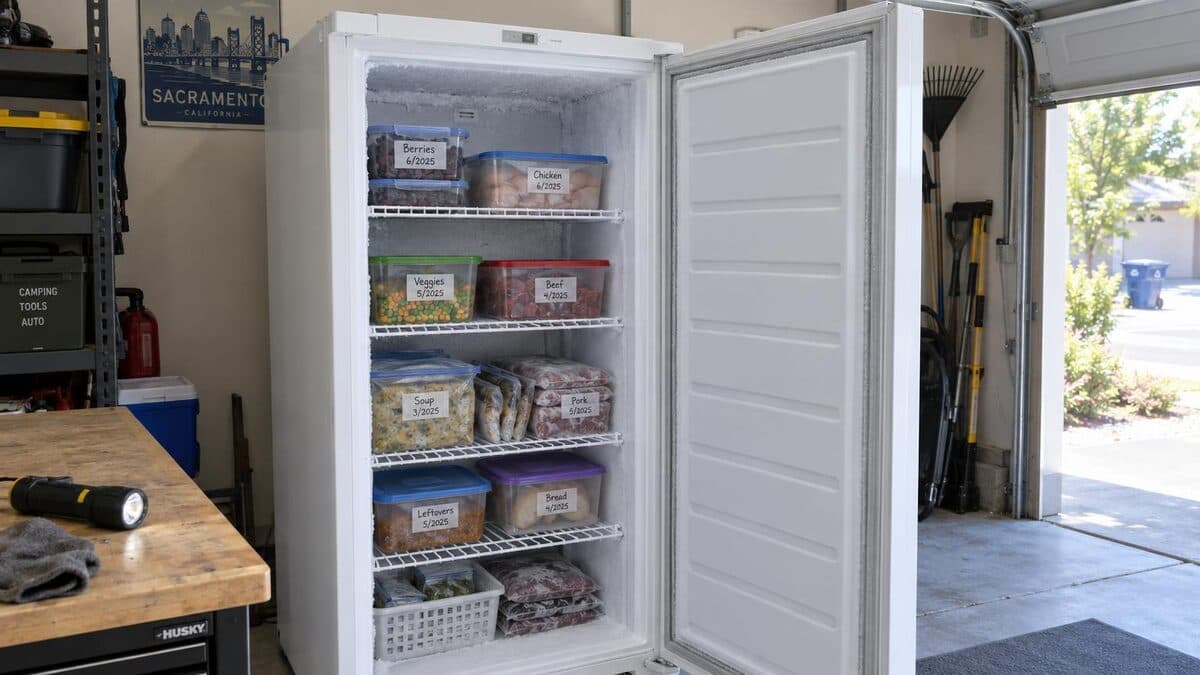
Upright freezers come in two types, and they fail differently. A manual-defrost model has its cooling coils built into the shelves; you can see frost forming on them. A frost-free model hides its coil behind a panel at the back, with a fan that blows cold air through a vent and a heater that melts frost off the coil several times a day.
Your manual or the label inside the door tells you which you have. If the shelves are wire racks and the back wall is smooth with a vent, it is frost-free.
Start With the Door Seal
Upright freezers lose cold air every time the door opens, because cold air is heavy and spills out the bottom. A seal that leaks when the door is closed makes that loss constant. Close the door on a sheet of paper at several points around the gasket and pull it out. Where it slides out with no resistance, the seal is not holding.
Look for gaskets that are torn, flattened or pulled out of their channel, and for frost building up in one corner of the door, which marks a leak. Also check that nothing on the door shelves, and no overfilled bin, keeps the door from closing all the way. A freezer that sits tilted forward lets the door swing open on its own; it should lean very slightly back.
Frost and the Air Vent
On a manual-defrost model, frost is the most common reason for soft food. Once it passes about a quarter inch, unplug the freezer, move the food to coolers, and let it thaw with the door open and towels on the floor.
Do not chip at ice with a knife or tool. One puncture of a shelf coil ends the freezer.
On a frost-free model, check the vent on the back wall. Bags and boxes pushed against it block the airflow, and the top shelf warms first.
Leave a couple of inches of space in front of the vent.
Clean the Condenser Coils
The condenser coils release the heat the freezer pulls out of the food. On most uprights they sit behind a grille at the bottom or across the back. In a Sacramento garage they collect dust, lint from a nearby dryer and pet hair fast, and coils blanketed in dust cannot shed heat, so the freezer runs longer and still warms up.
Unplug the freezer, then vacuum the coils with a brush attachment.
Plug it back in and give it a few hours. While you are there, listen for the small condenser fan near the compressor on models that have one. A fan that stays still while the compressor hums is a part that needs replacing.
When a Frost-Free Model Stops Defrosting
A frost-free upright with a soft top shelf and frost behind the back panel has a defrost problem. The defrost heater, its thermostat or the timer or control board has failed, the coil has iced over, and the fan cannot push air through it. You often see frost on the back wall or around the vent, and sometimes hear the fan scraping ice.
Here is a typical fall call in Rancho Cordova. A frost-free upright in the garage keeps ice cream soft on the top shelf while the bottom stays frozen. The evaporator coil behind the panel is a solid block of ice, and the defrost heater tests open. A new heater and a full manual defrost have it freezing evenly again.
When to Call a Pro
Call when the seal, the vent and the coils check out but the freezer still runs above 0°F, when a frost-free model has ice behind the back panel, when a fan does not run, or when the compressor runs constantly without getting cold. Those point to defrost parts, a fan motor, or a refrigerant or compressor problem. If the freezer is old and the repair is large, compare it with a new ENERGY STAR certified model.
PRO MAX HVAC & Appliance Repair handles freezer repair across the Sacramento area, including Rancho Cordova and Fair Oaks. Call (916) 234-5925 or book through our online booking page.
Check an upright freezer that is not freezing
Check the temperature
Put a freezer thermometer on a middle shelf and read it after a few hours; the target is 0°F.
Test the door seal
Close the door on a sheet of paper at several points around the gasket; if it slides out easily, the seal is leaking there.
Look at the frost
On a manual-defrost model, defrost it when the frost reaches about a quarter inch thick.
Clear the vent
On a frost-free model, move packages away from the air vent on the back wall so cold air can circulate.
Clean the condenser coils
Unplug the freezer, then vacuum the coils at the back or behind the bottom grille and plug it back in.
Sources
Need appliance repair in the Sacramento area?
Same-day service, 180-day warranty, all major brands. PRO MAX HVAC & Appliance Repair — Carmichael, CA.