Reviewed by PRO MAX HVAC & Appliance Repair technicians, EPA 608 certified
An electric oven not heating up while the cooktop still works almost always has a failed bake element. Run a bake test and watch the element: if an exposed element stays dark, or shows a blister or a break, it has failed. If the element glows and the oven still runs cold, the temperature sensor or the control board is the problem.
Small temperature losses add up in an oven. The U.S. Department of Energy notes that every time you open the oven door, the temperature inside can drop 25°F. A healthy bake element recovers that loss in a few minutes. A weak one never catches up, which is why a failing oven often shows up first as a holiday roast that takes an extra hour.
Why Does the Cooktop Work When the Oven Will Not Heat?
The cooktop and the oven use separate heating parts, so a working cooktop rules out very little. The burners have their own switches and elements. The oven runs through a bake element on the bottom, a broil element on the top, a temperature sensor on the back wall and a relay on the control board. Any one of those can fail while the cooktop keeps working.
The bake element fails most often, because it cycles on and off at full power every time you bake. Over years, the metal sheath develops a hot spot, then a blister, then a break.
Run a Bake Test and Watch the Element
Set the oven to bake at 350°F and watch the lower element through the window. A working exposed element starts to glow dull red within a minute or two. If it stays dark while the display says it is preheating, the element or the power feeding it has failed.
Then check the broil element the same way by setting the oven to broil. If broil glows and bake does not, you have narrowed it to the bake circuit. If neither one heats and the display is on, check that the range's double breaker in your electrical panel is fully on; a half-tripped breaker can leave the clock lit and the oven cold.
Here is a typical pre-Thanksgiving call. The house is a 1970s ranch in Fair Oaks with the original wall oven replaced around 2012. The owner notices cookies coming out dark on top and raw on the bottom. The bake element has a split the size of a grain of rice near the back. The broil element has been doing all the work from the top, which is exactly what that browning pattern looks like.
Inspect the Element When the Oven Is Cool
With the oven off and fully cool, look along the length of the element. Blisters, bubbles, a crack or a visible break all mean it has failed. A section that looks dull or ashy compared with the rest is the next sign.
Many newer ovens hide the bake element under a smooth floor panel. If your oven floor is flat, you cannot see it glow, and the clues are indirect: a preheat that takes far longer than it used to, or pale bottoms and dark tops on baked goods. Getting to a hidden element means removing the oven floor or rear panel, so leave that to a technician.
When the Element Is Fine but the Oven Runs Cold
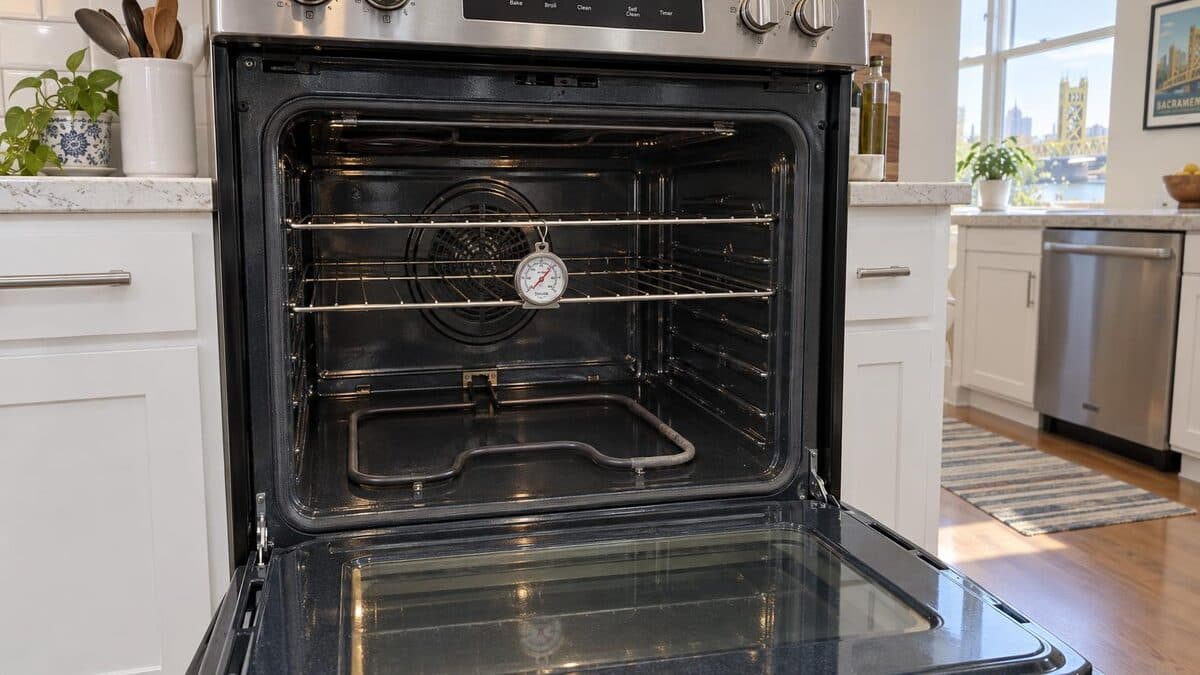
Test the temperature before you blame the sensor. Hang an oven thermometer on the center rack, preheat to 350°F, wait 20 minutes, then read it without opening the door. A reading within about 25 degrees of the setting is normal swing. More than that points to a drifting calibration, a failing temperature sensor or a control relay.
Most electric ovens let you adjust the calibration offset from the control panel, and your manual shows the button sequence. Our position: adjust the offset only when the oven is steady but consistently off. If the reading jumps around, or the oven was fine last month, a part is failing, and an offset only hides it.
It is also worth checking the CPSC recall database for your range or wall oven model if it is acting strangely, since a recalled control is replaced at no cost.
Repair or Replace the Oven
Repair is the right call for most electric ovens. An exposed bake element is a common, inexpensive part, and a temperature sensor is similar. A control board costs more, but on a range under about 12 years old with a sound cavity and door, it is still usually worth fixing. Replacement makes sense when the board has failed on an older range, or when the door, hinges and cavity are worn too.
When to Call a Pro
Call when the element looks fine but the oven still will not heat, when the oven has a hidden element, when the oven thermometer reading is erratic, or when the display shows an error code that returns after you turn the breaker off and back on. Bring us the model number and any code, and we can usually arrive with the right part.
PRO MAX HVAC & Appliance Repair handles oven repair across the Sacramento area, including Fair Oaks and Roseville. Call (916) 234-5925 or book through our online booking page before the holiday baking starts.
Check an electric oven that is not heating up
Confirm the oven has power
Check that the clock and display are on and that the range's double breaker in the panel is fully on.
Run a bake test
Set the oven to bake at 350°F and watch the lower element through the window for two minutes; a working exposed element glows red.
Inspect the element when cool
With the oven off and fully cool, look for blisters, cracks or a break along the element.
Check the temperature
Hang an oven thermometer on the center rack, preheat to 350°F, wait 20 minutes and compare the reading to the setting.
Note any error code
Write down any code on the display so a technician can bring the right part.
Sources
Need appliance repair in the Sacramento area?
Same-day service, 180-day warranty, all major brands. PRO MAX HVAC & Appliance Repair — Carmichael, CA.