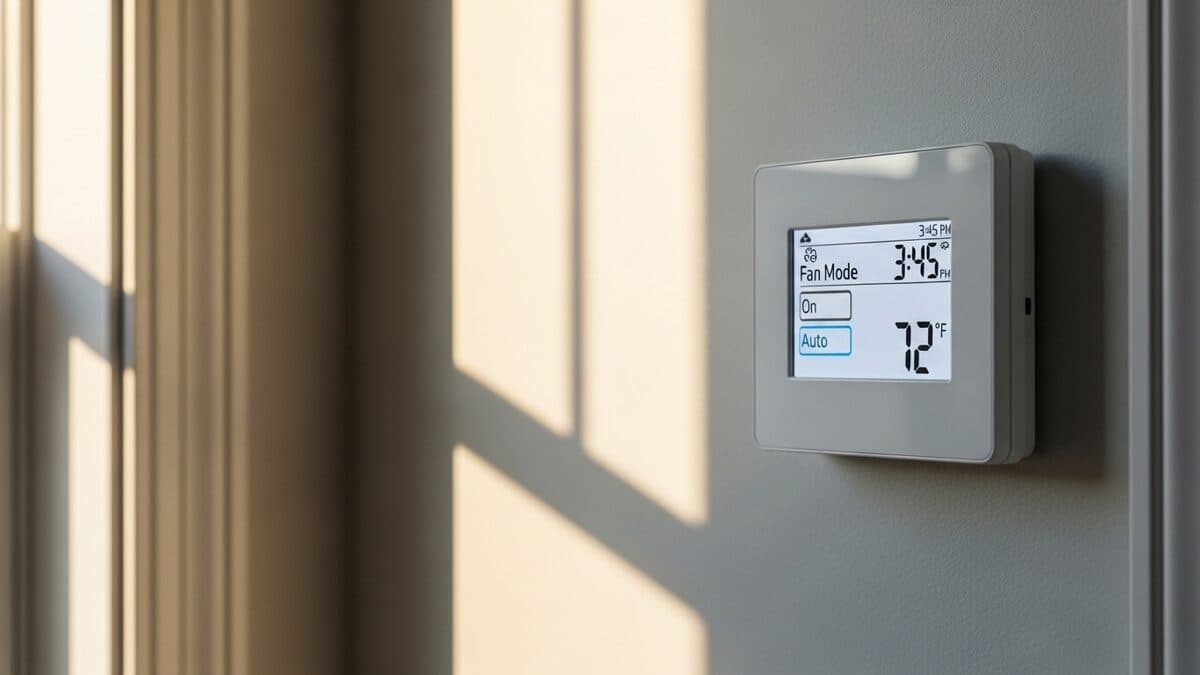
AC Fan On vs Auto in Sacramento: Set It to 'Auto' During a Heat Wave
Set your thermostat fan to 'Auto' during a Sacramento heat wave — it uses less electricity, keeps your air cooler, and protects your filter. If you've ever asked why your HVAC fan is always running, the answer is usually that it's set to 'On,' which forces the blower to run 24/7 regardless of whether your AC is actually cooling. During July in the Sacramento area, when triple-digit afternoons are routine, that distinction directly affects your comfort and your SMUD bill. According to the ENERGY STAR, proper thermostat settings are one of the most direct ways to cut cooling costs, and your fan mode is part of that equation.
Here's what each setting does, why 'Auto' wins in our dry heat, and when a constantly running fan signals a real problem.
What 'On' and 'Auto' Actually Do
'Auto' runs the blower only while the AC is actively cooling; 'On' runs the blower continuously, all day and night. That's the core difference. In 'Auto,' when your compressor cycles off after hitting the setpoint, the fan stops too — so you only pay to move air when that air is being cooled.
In 'On' mode, the blower never stops. When the compressor is off, the fan keeps pushing air through your ducts and vents. In a Carmichael or Citrus Heights attic that's easily 130°F on a July afternoon, that ductwork is hot. The fan pulls warm, uncooled air across those ducts and delivers it into your rooms between cooling cycles. You feel a breeze, but it's a warm one — which is exactly why homes on 'On' often feel less comfortable during a heat wave, not more.
Why 'Auto' Wins in Sacramento's Dry Heat
'Auto' saves electricity and keeps your delivered air colder, which matters most when it's 105°F outside. The blower motor is one of the larger electrical loads in your system, and running it around the clock adds up over a long Sacramento summer. Switching to 'Auto' cuts that runtime to only the hours your AC is actually cooling.
There's a humidity angle too, though it works in our favor. In humid coastal climates, 'On' mode is a real problem because the continuous airflow blows moisture off the evaporator coil back into the house. Sacramento's climate is dry, so that specific downside is less of a concern here. But dry climate or not, 'Auto' remains the more energy-efficient choice — and it comes with no humidity penalty worth trading off.
The Filter Cost of Running 'On'
Running the fan on 'On' clogs your filter roughly twice as fast during a Sacramento summer. The blower pushes air through the filter continuously — even when no cooling is happening — so the filter sees far more total airflow. Add open doors, dusty outdoor air off dry lawns, and periodic wildfire smoke, and a filter that would normally last a month can choke in half that time.
A clogged filter restricts airflow, which forces your AC to work harder and is a leading reason people wonder why their HVAC is not cooling well. Worse, starved airflow across the evaporator coil is a common trigger for a system to freeze up — ice forms on the coil, blocks airflow entirely, and shuts cooling down when you need it most. So 'On' mode doesn't just waste power; it can set off the exact failures you're trying to avoid on a 100°F+ day in Roseville or Fair Oaks.
When 'On' Actually Makes Sense
Use 'On' for short, targeted situations — not as a summer default. There are legitimate uses. If one room in a Rancho Cordova or Gold River home runs stuffy and you want steadier air circulation for an hour or two, 'On' can help even out the temperature. Some homeowners also run 'On' briefly while filtering smoke through a high-quality filter on a bad air-quality day.
The key word is short. Flip it to 'On' when you have a specific reason, then return it to 'Auto.' Leaving it on 'On' all season is where the energy waste and filter problems pile up.
Keeping Up on Triple-Digit Days
Basic maintenance keeps your AC cooling through a heat wave — start with the filter and the outdoor unit. Check and replace your air filter every 30 days during peak summer, more often if you're running 'On' or dealing with smoke. Keep the outdoor condenser clear of leaves, grass clippings, and clutter, with at least two feet of clearance on all sides so it can shed heat.
Set the fan to 'Auto,' and raise your setpoint a few degrees during SMUD peak hours from 4 to 9 PM to ease strain during the hottest, priciest part of the day. Knowing how to handle HVAC maintenance at this level prevents most mid-summer breakdowns. If your system runs constantly and still can't hold temperature on 100°F+ days, that's a sign to think about when to replace an HVAC system or upgrade to the best HVAC system for your home's size — a conversation worth having with a pro before next summer.
When to Call a Pro
Call a professional if your fan won't shut off on 'Auto,' if the system freezes up, or if it runs when the thermostat is off. A blower that keeps running in 'Auto' points to a stuck relay on the control board or a shorted thermostat wire — both need a technician to avoid straining the compressor. The same goes for a system that runs when the thermostat is fully off.
If your coil ices over, your AC won't cool, or the unit can't keep pace on a Rocklin scorcher despite a clean filter and clear condenser, don't keep cycling it — that risks compressor damage. A tune-up catches low refrigerant, weak capacitors, and airflow problems before they leave you without cooling in the worst heat.
Set your fan to 'Auto,' keep that filter fresh, and call PRO MAX HVAC & Appliance Repair at (916) 234-5925 when your system needs a hand. You can also book online on our /contact page — we'll keep you cool through the rest of the Sacramento summer.
Need appliance repair in the Sacramento area?
Same-day service, 180-day warranty, all major brands. PRO MAX HVAC & Appliance Repair — Carmichael, CA.