Why Is My HVAC Not Cooling My House After Another Smoky Sacramento Summer?
Your HVAC isn't cooling well because wildfire smoke leaves behind more than a dirty filter — it fouls the evaporator coil and loads the blower wheel with fine particulate that restricts airflow long after the smoke clears. Wildfire smoke carries PM2.5 particles, fine particulate 2.5 micrometers or smaller, that pass through standard filtration and settle directly onto coil fins, blower blades, and motor bearings. After a summer of smoke advisories across Sacramento, Carmichael, Roseville, and Rocklin, homeowners are right to wonder whether their system took on real, lasting wear — not just a filter that needs swapping.
What Wildfire Smoke Does Inside Your System
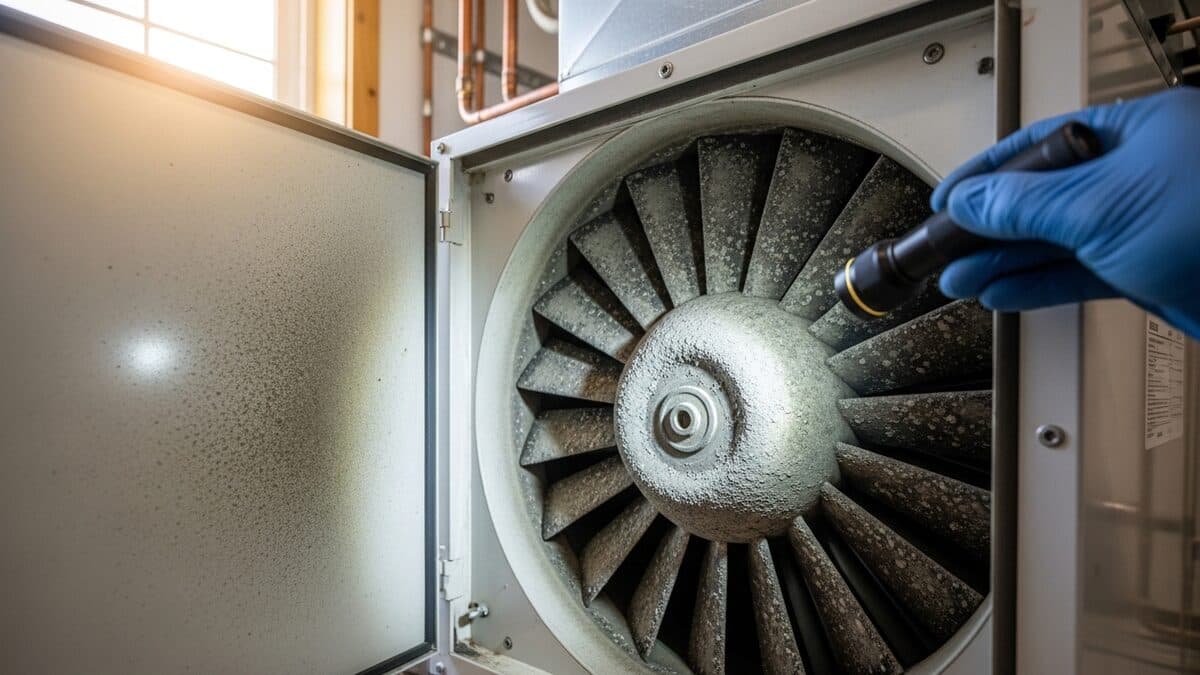
Wildfire smoke behaves differently than ordinary household dust. It's finer, stickier when combined with humidity, and produced in volumes that overwhelm a standard 1-inch filter within days during an active smoke event. Once particulate gets past the filter, it travels straight into the air handler, where it coats the blower wheel, settles on the evaporator coil, and works into motor bearings and electrical contacts. None of this shows up by looking at your thermostat — it shows up as reduced airflow, weaker cooling, and new noises that weren't there before the smoke rolled in.
The Blower Wheel Takes the Hardest Hit
A dirty blower wheel is usually the first sign something changed after a smoky week. Fine ash and soot coat the blades unevenly, throwing the wheel out of balance the same way mud on a car tire causes a wobble at speed. That imbalance shows up as a new rumble, hum, or vibration when the system starts up or runs — which answers the common question of why is my HVAC so loud after a heavy smoke stretch. Left alone, the added friction wears down motor bearings faster than normal use ever would, and a blower motor replacement costs far more than a cleaning would have.
Coil Fouling and Reduced Cooling Capacity
A fouled evaporator coil is the main reason your HVAC stops cooling effectively even when the outdoor temperature and refrigerant charge haven't changed. Smoke particulate settles into the coil fins and reduces the surface area available to absorb heat from your indoor air. The system compensates by running longer cycles to hit the same setpoint, which drives up utility bills and accelerates wear on the compressor. This is also the most likely explanation when a homeowner in Fair Oaks or Gold River notices the system is technically running but the air blowing out doesn't feel cold — restricted heat exchange, not a refrigerant leak, is usually the culprit.
Filters Are Your First Line of Defense — But Not the Only One
A clean filter matters more during smoke season than any other time of year, but it's not a complete fix. During active smoke events, check your filter every 5–7 days and replace it as soon as it looks grey or feels dense to the touch — that can mean swapping it every one to two weeks instead of the usual monthly interval. Knowing when to replace your HVAC filter during a bad smoke stretch is only half the picture, though. Filters catch what passes through them going forward; they do nothing for the particulate that already settled on the coil and blower before the filter was changed. That's why a visual filter check should always be paired with a look at the coil and blower condition after a heavy smoke season, not treated as a standalone fix.
Noise, Airflow, and Knowing When Damage Is Serious
A sudden increase in noise or a drop in airflow after smoke exposure signals component-level buildup, not a system malfunction. If your HVAC is not blowing cold air the way it used to, start with the basics: shut the system off, replace the filter, and give any ice on the coil a couple of hours to thaw before restarting. If cooling doesn't bounce back, the coil is likely fouled deeper than a filter swap can fix. Persistent rumbling or grinding that doesn't go away after a filter change usually points to blower wheel buildup or bearing wear that needs a hands-on inspection rather than guesswork.
When to Replace vs. Repair After Repeated Smoke Seasons
Smoke exposure rarely forces a full system replacement on its own, but it accelerates the clock on equipment that's already aging. If your system is in the 12–15 year range, has needed more than one significant repair recently, and still struggles to cool well after cleaning, it's worth having a technician evaluate whether the blower motor, coils, and heat exchanger are holding up or nearing the end of their service life. Homeowners in Citrus Heights and Rancho Cordova with systems in that age range often find that a post-smoke inspection is the moment that clarifies whether another repair makes sense or whether replacement is the smarter long-term move.
When to Call a Pro
Call a technician when filter changes and basic airflow checks don't restore normal cooling or quiet operation. Coil cleaning and blower wheel cleaning are jobs that require the cabinet opened, the wheel or coil accessed directly, and — in many cases — specialized brushes or low-pressure cleaning solutions that aren't practical as a DIY project. Evaporator coil cleaning typically runs $150–$350 and blower wheel cleaning runs $100–$250 depending on system size and access, and combining both at one visit is more cost-effective than scheduling them separately. Skipping this service after a smoky season doesn't save money — it just shifts the cost toward a motor or compressor repair down the road.
If you're comparing the best HVAC companies near me for a post-smoke inspection, look for one that checks the coil and blower condition specifically, not just the filter and refrigerant charge — that's the difference between a surface-level tune-up and an inspection that actually catches smoke-related wear.
If your system has been running rough, loud, or weak on cooling since the last smoke event, PRO MAX HVAC & Appliance Repair serves Sacramento, Carmichael, Roseville, Citrus Heights, Fair Oaks, Gold River, Rancho Cordova, and Rocklin. Call (916) 234-5925 or book online through our /contact page to get your coil, blower, and filter checked before the next smoky stretch hits.
Need appliance repair in the Sacramento area?
Same-day service, 180-day warranty, all major brands. PRO MAX HVAC & Appliance Repair — Carmichael, CA.