Reviewed by PRO MAX HVAC & Appliance Repair technicians, EPA 608 certified
An oven temperature that is off by more than about 25 degrees usually has one of three causes: a calibration that has drifted over the years, a temperature sensor that reads wrong, or heat leaking past a worn door gasket. Test it with an oven thermometer before you change any settings. A steady error is a five-minute fix with the calibration offset. Readings that jump around mean a part is failing.
Ovens lose heat faster than most people think. The U.S. Department of Energy notes that every time you open the oven door, the temperature inside can drop 25°F. A healthy oven recovers in a few minutes. One with a drifting sensor or a tired heating element never quite catches up, which is why the problem shows up first on long holiday bakes and roasts rather than on a quick tray of fries.
How to Test Your Oven Temperature
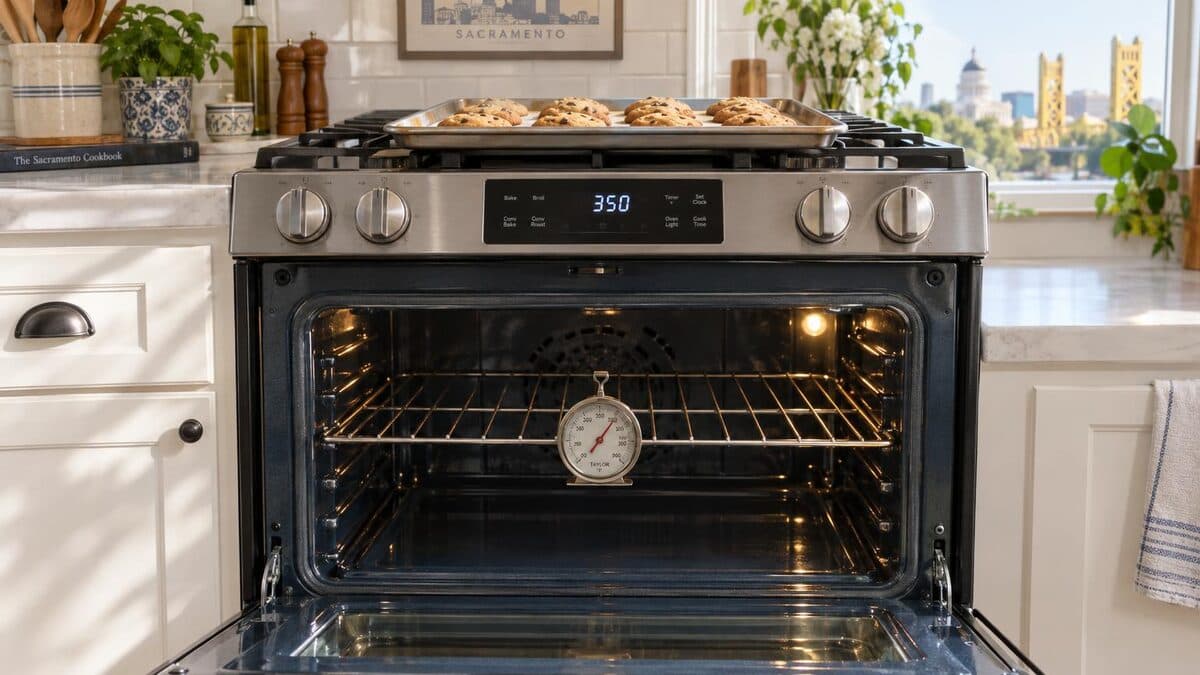
Use an oven thermometer, not the display. Hang it from the center of the middle rack, where you can read it through the window. Preheat to 350°F, then wait a full 20 minutes after the preheat signal. Many ovens beep before the whole cavity has settled, so reading too early makes a good oven look cold.
Take four readings, five minutes apart, without opening the door, and average them. Ovens cycle the heat on and off, so a single reading tells you little. An average within about 25 degrees of the setting is normal. A steady error of 30, 40 or 50 degrees is worth fixing.
Test with the racks where you usually bake and with nothing else in the oven. A pizza stone or a full load of pans changes how fast the oven recovers, which is useful to know but muddies a calibration test. If you bake on convection, run the same test with convection on, since many ovens adjust that setting automatically.
Setting the Calibration Offset
If the oven is consistently off in one direction, the calibration offset is the right fix. Most electronic ovens built in the last 15 years let you shift the temperature by about 35 degrees either way from a settings menu or a button combination; your manual shows the exact sequence. Older ovens with a dial often have a small adjustment screw behind the temperature knob.
Note the offset you set. A repair or a control reset can clear it.
Use the offset only when the oven is steady but wrong. If your thermometer readings swing widely from one check to the next, or the oven was accurate last month and is suddenly off, a part is failing, and an offset only hides it until the error grows.
When the Problem Is the Temperature Sensor
The sensor is the problem when the oven runs off by different amounts from day to day, or the error grows over weeks. It is a thin metal probe on the back wall of the oven, near the top, and the control reads its resistance to decide when to heat. When the sensor drifts, the oven runs hot or cold even though the display shows the right number.
Two quick checks are worth doing with the oven off and cool. Make sure the probe is not bent so it touches the oven wall, which throws off the reading. Then look for an error code on the display, since many controls flag an open or shorted sensor. Testing the sensor's resistance takes a meter and the model's spec, so that part is for a technician. A replacement sensor is one of the simpler oven repairs.
Heat Escaping or Not Keeping Up
A worn door gasket lets heat escape around the edges. Run your fingers along it with the oven cool. A gasket that is flattened, torn or pulling away from the door needs replacing, and you will often see brown streaks on the cabinet above the door from escaping heat.
An oven that runs cold and preheats slowly can also have a weak heat source. In an electric oven that is usually the bake element; in a gas oven, a weak igniter that opens the burner valve late. Both show up as long preheats and pale-bottomed bakes.
An oven that runs much hotter than the setting, or keeps heating after it reaches temperature, points to a control relay that is sticking. That one needs a technician promptly.
Gas ovens add one more wrinkle. Their flame cycles fully on and fully off rather than throttling down, so the swing between readings is often wider than on an electric oven, even when the average is right on target. Judge a gas oven by the average of your four readings, not by the highest or lowest one.
Here is a typical pre-holiday call in Fair Oaks. A 12-year-old range bakes everything about 40 degrees cold, and the owner has been adding time to every recipe for a year. The thermometer test shows a steady 40-degree drop with tight readings. An offset of plus 35 brings it within range in five minutes, and nothing needs replacing.
When to Call a Pro
Call when your thermometer readings swing widely, when the oven runs hot, when it shows a sensor error, or when an offset does not hold. Check the CPSC recall database with your model number too if the controls are acting strangely.
PRO MAX HVAC & Appliance Repair handles oven repair across the Sacramento area, including Fair Oaks and Roseville. Call (916) 234-5925 or book through our online booking page before the holiday baking starts.
Test and calibrate an oven that runs hot or cold
Place an oven thermometer
Hang an oven thermometer from the center of the middle rack, where it is easy to read through the window.
Preheat and wait
Preheat to 350°F, then wait 20 minutes after the preheat signal so the whole oven settles.
Take several readings
Read the thermometer four times, five minutes apart, without opening the door, and average the readings.
Set the offset
If the average is steadily off by more than about 25 degrees, use the calibration or temperature offset setting your manual describes.
Retest
Repeat the test; if the readings still jump around or the error returns, book a repair for the sensor or controls.
Sources
Need appliance repair in the Sacramento area?
Same-day service, 180-day warranty, all major brands. PRO MAX HVAC & Appliance Repair — Carmichael, CA.