Reviewed by PRO MAX HVAC & Appliance Repair technicians, EPA 608 certified
A furnace blower motor replacement is the right call when the motor itself has failed, but most blower complaints turn out to be something cheaper: a weak run capacitor, a blower wheel packed with dust, or a filter choking the airflow. Rule those out first. If the motor still hums without spinning, quits on its own or grinds, it is time to replace it.
The motor you replace it with matters more than it used to. Under the U.S. Department of Energy furnace fan efficiency standard, in effect since July 2019, new residential gas furnaces moved almost entirely to high-efficiency blower motors. Many furnaces in homes around Sacramento are older than that rule, which opens a real choice when the original motor wears out.
Signs a Furnace Blower Motor Is Failing
A failing furnace blower motor usually gives warning before it stops. The signs worth watching for:
- A hum with no air moving. The motor gets power but cannot start, often because the capacitor that helps it start has weakened.
- A fan that runs a while, then quits. The motor overheats, its internal thermal protection shuts it off, and it restarts once it cools.
- Grinding, screeching or a rising whine from the lower cabinet, which points to worn bearings.
- Weak airflow with a clean filter, because a tired motor no longer reaches full speed.
Check the thermostat fan setting and the filter before anything else. A blower that never shuts off is usually a fan switch set to On, not a motor problem.
Rule Out the Cheaper Fixes First
Three things cause blower symptoms without the motor being bad.
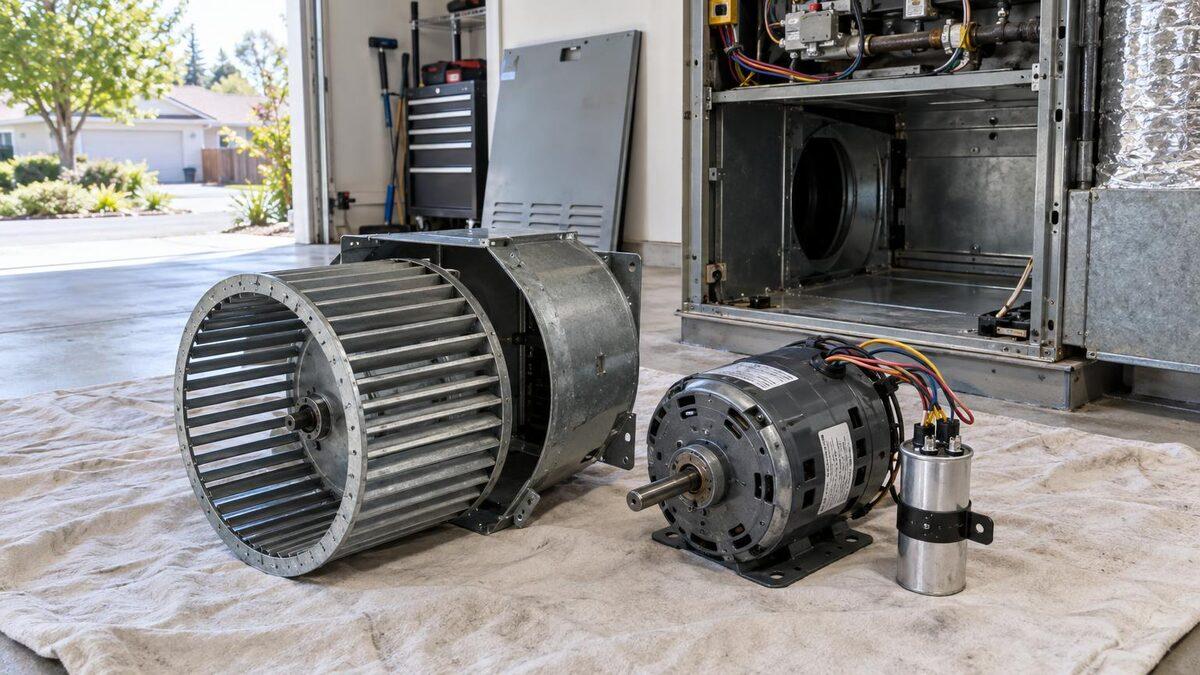
The run capacitor is the first. Most older blower motors use one, a small metal can wired beside the motor, and it weakens with heat and age. A weak capacitor produces the classic hum-and-no-spin, and it also makes the motor run hot and slow. Replacing it is one of the shortest furnace repair jobs there is.
The blower wheel is the second. Dust packs the curved blades over years, and a packed wheel moves far less air at the same speed. The motor works harder, runs hotter and wears out sooner. Pulling and cleaning the wheel often restores airflow by itself.
Airflow is the third. A clogged filter, closed registers or a blocked return grille all make a blower motor labor. Fix those and an overheating motor often settles down.
Repair or Replace the Motor
Some blower motor problems are repairable, and the order of operations is simple: cheapest fix first.
On older furnaces, the motor is usually a permanent split capacitor motor, the kind that runs at a few fixed speeds and depends on that capacitor. If the capacitor is fine and the wheel is clean, worn bearings or a burned winding mean the motor itself is done. Those motors are not rebuilt in the field. They are replaced.
On newer furnaces, the motor is usually an electronically commutated motor, often called an ECM. It has a control module bolted to the back of the motor, and on many models that module fails before the motor does. Replacing just the module is a real option on those units.
Our position: on an older furnace with a dead fixed-speed motor, ask about a constant-torque replacement motor rather than a like-for-like swap. These motors are built to drop into older furnaces, run cooler and use less electricity, and they fit most residential cabinets with minor wiring changes. On a furnace near the end of its life, though, a new motor in a 25-year-old cabinet is money better put toward replacement.
A Typical Blower Motor Call
A typical early-winter HVAC call in a Fair Oaks home goes like this: the furnace lights, the burners run, and then the furnace shuts off on its high limit because the fan is barely turning. The owner hears a low hum from the lower cabinet. The filter is new.
The capacitor tests well below its rating. A new capacitor gets the motor spinning at full speed, and the furnace runs a full cycle. The bearings are quiet and the wheel is clean, so the motor stays.
That is the pattern worth knowing. A hum from the blower compartment is a capacitor test before it is a motor replacement.
What Replacement Involves
A blower motor replacement means pulling the blower assembly out of the furnace, separating the motor from the wheel, and installing a motor matched to the furnace's horsepower, rotation and speed settings. The technician then sets the blower speed so the temperature rise across the furnace lands inside the range on its rating plate.
That last step is the one that gets skipped. A motor installed at the wrong speed either starves the heat exchanger of air or blows lukewarm air, and both shorten the furnace's life.
When to Call a Pro
Call a pro when the blower hums without spinning, quits on its own after a few minutes, makes grinding or screeching noise, or moves weak air with a clean filter. Testing a capacitor, a motor winding or an ECM module takes a meter and the panels off. In California, that work belongs to a contractor with a C-20 heating and air-conditioning license, which you can check in under a minute on the Contractors State License Board site.
PRO MAX HVAC & Appliance Repair tests and replaces furnace blower motors across the Sacramento area. Call (916) 234-5925 or book a visit on our contact page to get full airflow back before the next cold night.
Sources
Need appliance repair in the Sacramento area?
Same-day service, 180-day warranty, all major brands. PRO MAX HVAC & Appliance Repair — Carmichael, CA.